After spending a few days thinking about little besides snow, I want to take an hour and try to write about reading assessment, and in particular about the kind of natural assessment that can happen in a conversation about a book.
All assessment is formative, and all assessment is also instruction
The only valid educational reason for assessment is to improve education; therefore, anything we think of as "summative" should probably be re-engineered to make it more formative. In addition, assessment is always, inevitably, teaching something, and we should consider, before we assess, what our assessment will teach. But that's abstract...
Conversation and discussion as assessment
One good way to assess student reading is through conversation and discussion. In a discussion about a text she has read, the student should get a lot of truly immediate feedback about her reading.
While my students are reading in class, I go around and talk to individual students. Sometimes these conversations are on a specific topic common to the whole class: in our grammar unit, for instance, I will have quick check-ins with kids about, say, prepositional phrases on the page they are reading; if I've assigned the class an essay about point of view, we will talk about that. At other times, however, the conversations are totally individualized, organic exchanges in the style (I think) of Nancie Atwell, about particular issues in the books they are reading on their own, and sometimes about particular passages from these books (I usually stick to the passage they happen to be on just then).
Usually I have not read these books--and if I have read them, I don't remember the details all that well--so the student is of necessity playing the role of the expert. This is a good role for a student to play in an assessment, since it empowers her to put on her best performance. If, as in most classroom situations, not to mention most assessments, the student is not the expert, then she is put in a position of wanting to say what the teacher thinks is right, and it's hard for either the student or her teacher to get a sense of the quality of her own independent thought.
When I have a conversation like this, I think my job is to ask the student questions that will get at the quality of her reading and make her thinking more visible to herself and to me--so that she can see what she knows, how she knows it, and what she doesn't know. I ask different questions depending on the student. Sometimes I start out with a general question. If the student is just starting a book, I might ask, "Are you liking it so far?" Whether the answer is yes or no, I might ask, "Why?" Or: "What's good about it?" Sometimes, instead of starting with a question, I start by having the student read to me for a half a page or so. This is another kind of assessment, and one I don't even have to give feedback on--the kid can hear, herself, where she is stumbling.
When students have to stop and think
As I follow up, either on my original question or on the passage the kid read to me, the questions narrow to a particular focus, and very quickly we get to a question that the student doesn't know the answer to already. In some cases these questions are ones that I would expect to be obvious, like, "Why is the main character so angry at her friend?" In that case, the student's confusion is very interesting, since we would seem to be identifying a basic problem with comprehension, yet doing so in a way that might seem inherently interesting, and in a way that encourages the student to find out the answer, rather than, as on a standardized assessment, putting the emphasis on the student's failure to figure out what the teacher or state already know, and with little opportunity for immediate follow-through.
In other cases the questions that give the student pause are more difficult or literary, like "Why do you think the author started the book with this scene?" or "How could you tell that she was angry?" In these cases, too, we are noticing what the student has already considered and what she has not given a thought to. (At other times, the students get something obviously wrong, and the teacher can follow up in a gentle and friendly way and allow the student to figure out for herself what she was confused about and why.)
One thing that's striking in doing these one-on-one conversations is how quickly we get to points at which the students need to stop and think before they respond. This stopping and thinking is a pretty big difference between thoughtful intellectual conversations and the usual adolescent repartee. As I remember from my own youth and observe in my students, adolescent conversations are mainly about loud, immediate disagreement or loud, immediate agreement. The loudness and immediacy overwhelms most of the potential for thoughtful critical analysis. One-on-one conversations in the classroom, conducted in a whisper and aiming less at feel-good agreement or dramatic disagreement, are dramatically different, not least because they lead to so much stopping and thinking.
My guess is that this stopping and thinking is when much of the learning happens, as students see what they understand and what they don't, and as they think through new ideas that they haven't thought about before. For the conversation is not only assessment, but is also a form of instruction. In my questioning I am instructing them in ways of looking at a book, in categories of literary thought, in literary vocabulary, and so on.
Disadvantages of this method of assessment
The major disadvantage of these individual conversations is that each student can't get very much of my time. If it takes a couple of minutes for the class as a whole to settle down enough for me to start talking to kids individually, and if each conversation takes four minutes, and if also I want to quickly check on what progress the other kids in the class have made, then I can get through four conversations in a twenty-minute independent reading period. That means, for my sixteen-student classes, that I can talk to each kid individually for four minutes each week. That's not very efficient.
Another disadvantage is that the assessment is not uniform. I'm not checking each kid against the same benchmark, so it's not easy to compare. Another disadvantage is that these assessments are often random, coming organically out of whatever passage the kid happens to be reading right then. Of course, these two disadvantages are also advantages, since the lack of uniformity means that the assessments are better suited to the individual students and the randomness of the passages often sparks my thinking in ways that I couldn't have anticipated.
A last disadvantage is that it's been hard, at least for me, to keep good records of this kind of qualitative, individualized assessment, so it's hard to measure progress and to follow up. I have to confess that in my preliminary experiments with this kind of assessment, I haven't yet figured out a good record keeping system. It needs to be very simple, because I, like Ben Franklin, am not very organized. I'm going to work on this over the next month or so, and I'll follow up with another post, in which I also give some more specific examples of these kinds of conversations.
Conclusion
Most people think about assessment in the same way Mr. Google does (google "reading assessment" to see what I mean): that is, as standardized tests, usually written, administered, by all-knowing adult authorities, upon children who are probably all too aware that (1) they're being tested and (2) that the assessment is of very little interest to either the adult or kid except as an assessment. So perhaps the best thing about using an informal conversation about an independent reading book as an assessment is that it doesn't feel like an assessment. All of what I'm saying here seems incredibly obvious--probably even when Rousseau said it it seemed pretty obvious--but it might be worth reminding ourselves that assessment is about more than just testing.
*****************************************************************
Post Script: Similarity to what happens naturally in a literate family; limitations of school
The kind of conversations I've discussed are essentially like the conversations that we have with children in our own homes, starting with the conversations we had when we were reading picture books to them. The fact that I think doing this in a classroom for four minutes a week is worthwhile is quite amazing, given that many four-year-olds get this kind of treatment for twenty minutes every single night.
This points, perhaps, to the limitations of school. There's no way that I can possibly do as good a job, as an English teacher responsible for the reading and writing of 85 children, as I do as a father responsible for the reading and writing of two children. In a sense that's okay--as long as what they do with me is worthwhile--but it's worth remembering the limitations of the system in which we work.
Showing posts with label class size. Show all posts
Showing posts with label class size. Show all posts
Monday, February 11, 2013

Sunday, November 4, 2012
Election special: Presidential Prep Schools (Part I)
Our
presidential candidates, like most of the US plutocracy, attended
private high school. I'm interested in the differences between the education and literacy
of the elite and the education and literacy of the masses, so I spent
an hour or so looking at the Presidential prep schools: the Punahou
Academy (Obama) and the Cranbrook school (Romney), and another hour or so trying to think about the differences between these schools and public schools. I find it troubling that our elites are withdrawing more and more from the spheres that the rest of us inhabit, and the private school/public school divide is just one rift among many. What does this divide look like, and what does it mean? I'm not really sure, but I've written two posts trying to explore the matter. This first post is about Punahou and Cranbrook in general, and I'll post something tomorrow about what the schools' English departments say they're doing.
General differences between private high schools and public high schools
These high schools are different from public high schools mainly in their student populations. The main reason Obama, Romney, Gates and other elites go to private school is that private schools are allowed to exclude kids who are less docile, less privileged, and less able. Good public schools are mostly "good" because they enroll more docile, privileged and able students, and low-performing public schools are mostly bad because they enroll less docile, less privileged, and less able students. Elite private schools take this difference between "good" public school and "bad" public school to a whole different level, since even at Leafstrewn we don't actively select our students. Punahou and Cranbrook are able to hand-pick their students, and their enrollments are made up almost entirely of extremely privileged and genetically fortunate children (according to an interesting study differences in academic ability among rich kids are at least 50% genetic, whereas among poor kids environment accounts for 90% of academic ability). At Punahou or Cranbrook, the few scholarship kids, like the young Barack Obama, are rare birds completely unrepresentative of their poorer peers (and Obama was hardly poor). This hand-picked student body is by far the most important difference between a private and a public school, since students are the most important factor in student achievement at any school, more important than the curriculum, the teachers, or even the budget. .
Non-academic factors also matter
The student population is also important for non-academic reasons, of course. Just as I myself prefer public schools (as a teacher and a parent) for non-academic reasons, many people prefer private schools for non-academic reasons. Having different populations means that the friends children make are different; the parent population is different; and the culture is different. But the differences go beyond population.
For one thing, the physical plant is usually dramatically different. My son goes to public school in a scary, depressing, prison-like structure:

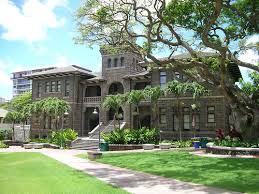
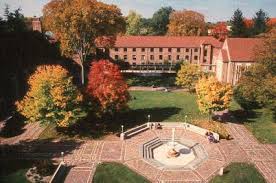
Our President and his opponent, on the other hand, went to lushly landscaped academic chateaux. (Cranbrook's campus, below left, was called, by the New York Times's architecture critic, "one of the greatest campuses ever created anywhere", and Punahou, at right, reminds me somehow of the Hearst castle at San Simeon):
Academic differences beyond the student population
Aside from the populations, and aside from the culture and the architecture and the groundskeeping, these private schools are also dramatically different from public schools in two ways: (1) they have lower student-teacher ratios; (2) they are not bound by governmental curriculum and testing requirements.
The student-teacher ratios at wealthy private schools are dramatically different from those even at public schools in wealthy towns. The public schools in leafy Bloomfield Hills, where Cranbrook is located, are relatively well-funded, and have extremely low numbers of students receiving free or reduced-price lunch. While nationwide about 50% of students are eligible for Free or Reduced Price lunch, the number in our own wealthy Leafstrewn is 13%, and in the Bloomfield Hills public schools it's even lower, somewhere between 2 and 8%. Nevertheless, whereas the public schools in Leafstrewn and Bloomfield Hills have student-teacher ratios of between 11 and 15, Cranbrook has a student-teacher ratio of 8.
Private schools are also not bound by nearly as many government rules. Punahou and Cranbrook both require standardized tests to get in, and both brag about their SAT results and their National Merit Semifinalists, but neither school subjects its students to the battery of standardized tests that are a yearly disruption of the routine at Leafstrewn and every other public school in the country. They are also free to run their schools, including their English departments, however they wish--but I'll wait until tomorrow's post to address that.
What do these differences mean?
One thing they mean is that when politicians or billionaires talk about school reform, it is hard for me to take their words at face value. If standardized testing is so important for improving schools, why don't elite parents push for their own children's schools to give the same tests? My son went to a private quaker school for a couple of years in between public schools, and he did not take the MCAS. Malia and Sasha do not have to take standardized tests every year. Why not? And if class size doesn't matter much, as Bill Gates is so fond of saying, why is it that Punahou and Cranbrook and Lakeside (Gates's alma mater) have dramatically lower teacher-student ratios than public schools do? (In fact the data is pretty clear: as you would expect, class size does matter, and it matters more for poor kids. The chair of Obama's council of economic advisors, Alan Krueger, has done great work on this--see his 2003 article, available here--but Arne Duncan has said that larger classes in high school might be a good idea.) So in my eyes, neither Presidential candidate has much credibility on education, and both ignore the most important factors in our country's educational health.
Another thing these differences mean is that we public school teachers might look at the curriculum and teaching at private schools, since they probably do things slightly differently. I've been thinking a lot about how we English teachers can learn from looking at doctors, at literature, at homeschooling, at international differences, and so on; prep schools are another interesting outside comparison. So tomorrow I'll say something about the way the two Presidential Prep schools say they handle reading, and I'll say which candidate I would vote for if all I knew was their high school's English department mission statement.
General differences between private high schools and public high schools
These high schools are different from public high schools mainly in their student populations. The main reason Obama, Romney, Gates and other elites go to private school is that private schools are allowed to exclude kids who are less docile, less privileged, and less able. Good public schools are mostly "good" because they enroll more docile, privileged and able students, and low-performing public schools are mostly bad because they enroll less docile, less privileged, and less able students. Elite private schools take this difference between "good" public school and "bad" public school to a whole different level, since even at Leafstrewn we don't actively select our students. Punahou and Cranbrook are able to hand-pick their students, and their enrollments are made up almost entirely of extremely privileged and genetically fortunate children (according to an interesting study differences in academic ability among rich kids are at least 50% genetic, whereas among poor kids environment accounts for 90% of academic ability). At Punahou or Cranbrook, the few scholarship kids, like the young Barack Obama, are rare birds completely unrepresentative of their poorer peers (and Obama was hardly poor). This hand-picked student body is by far the most important difference between a private and a public school, since students are the most important factor in student achievement at any school, more important than the curriculum, the teachers, or even the budget. .
Non-academic factors also matter
The student population is also important for non-academic reasons, of course. Just as I myself prefer public schools (as a teacher and a parent) for non-academic reasons, many people prefer private schools for non-academic reasons. Having different populations means that the friends children make are different; the parent population is different; and the culture is different. But the differences go beyond population.
For one thing, the physical plant is usually dramatically different. My son goes to public school in a scary, depressing, prison-like structure:
Our President and his opponent, on the other hand, went to lushly landscaped academic chateaux. (Cranbrook's campus, below left, was called, by the New York Times's architecture critic, "one of the greatest campuses ever created anywhere", and Punahou, at right, reminds me somehow of the Hearst castle at San Simeon):


Academic differences beyond the student population
Aside from the populations, and aside from the culture and the architecture and the groundskeeping, these private schools are also dramatically different from public schools in two ways: (1) they have lower student-teacher ratios; (2) they are not bound by governmental curriculum and testing requirements.
The student-teacher ratios at wealthy private schools are dramatically different from those even at public schools in wealthy towns. The public schools in leafy Bloomfield Hills, where Cranbrook is located, are relatively well-funded, and have extremely low numbers of students receiving free or reduced-price lunch. While nationwide about 50% of students are eligible for Free or Reduced Price lunch, the number in our own wealthy Leafstrewn is 13%, and in the Bloomfield Hills public schools it's even lower, somewhere between 2 and 8%. Nevertheless, whereas the public schools in Leafstrewn and Bloomfield Hills have student-teacher ratios of between 11 and 15, Cranbrook has a student-teacher ratio of 8.
Private schools are also not bound by nearly as many government rules. Punahou and Cranbrook both require standardized tests to get in, and both brag about their SAT results and their National Merit Semifinalists, but neither school subjects its students to the battery of standardized tests that are a yearly disruption of the routine at Leafstrewn and every other public school in the country. They are also free to run their schools, including their English departments, however they wish--but I'll wait until tomorrow's post to address that.
What do these differences mean?
One thing they mean is that when politicians or billionaires talk about school reform, it is hard for me to take their words at face value. If standardized testing is so important for improving schools, why don't elite parents push for their own children's schools to give the same tests? My son went to a private quaker school for a couple of years in between public schools, and he did not take the MCAS. Malia and Sasha do not have to take standardized tests every year. Why not? And if class size doesn't matter much, as Bill Gates is so fond of saying, why is it that Punahou and Cranbrook and Lakeside (Gates's alma mater) have dramatically lower teacher-student ratios than public schools do? (In fact the data is pretty clear: as you would expect, class size does matter, and it matters more for poor kids. The chair of Obama's council of economic advisors, Alan Krueger, has done great work on this--see his 2003 article, available here--but Arne Duncan has said that larger classes in high school might be a good idea.) So in my eyes, neither Presidential candidate has much credibility on education, and both ignore the most important factors in our country's educational health.
Another thing these differences mean is that we public school teachers might look at the curriculum and teaching at private schools, since they probably do things slightly differently. I've been thinking a lot about how we English teachers can learn from looking at doctors, at literature, at homeschooling, at international differences, and so on; prep schools are another interesting outside comparison. So tomorrow I'll say something about the way the two Presidential Prep schools say they handle reading, and I'll say which candidate I would vote for if all I knew was their high school's English department mission statement.
Subscribe to:
Posts (Atom)